The following notes were compiled from my own notes taken over the years, as well as notes from Dr. Charles Ryrie, Dr. Stanley Toussaint of Dallas Theological Seminary, Dr. J. Vernon McGee, Todd Hampson, Chuck Smith, and especially Dr. Chuck Missler, who remains the most knowledgeable and thorough Bible teacher I have ever known.
Please open your Bibles and follow along as the notes progress. To compress file space, I have not copied and pasted most of the passages referenced.
*Note that it is ONE Revelation. The book is not called ‘Revelations’. It’s not a collection of revelations, it is a single unveiling of Jesus Christ.
Note whose revelation it is – the book of Revelation is the ‘revelation of Jesus Christ’. Not the revelation of John.
It represents the consummation of all things – everything started in Genesis and everything is consummated in Revelation.
Revelation can be seen as a puzzle but all the clues to solving the puzzle are given elsewhere in scripture. So it’s a treasure hunt! Go to it, and enjoy having the Word revealed to you through the power of the Holy Spirit.
Revelation chapter one
1:1 ‘The Revelation of Jesus Christ, which God gave Him to show to His bond-servants, the things which must soon take place; and He sent and communicated it by His angel to His bond-servant John,’
To whom is this Revelation given? It is the revelation of Jesus Christ, which God gave unto Him. Who did He give it to? Jesus Christ! Why was it shown to Him? To show unto Christ’s servants things that must come to pass quickly. This passage helps illustrate the hierarchy of the Trinity – though Son is equal to Father, the Son has submitted to the Father in order to accomplish the Father’s will. They play different roles, if you will. Similar to (but distinct from) the different roles outlined in Ephesians 5 and Colossians 3. Hearkens back to Jesus’ submission in John 17.
The Revelation = ‘Apocalypsis’ = Unveiling (singular, not plural)
‘to show…’ This is not a sealed book (Rev. 22:10). It is to be understood, in contrast to Daniel (Daniel 12:4).
‘soon take place;’ (other versions say ‘shortly’) ‘en taxei’ – rapidly in execution (same root as where we get the word for tachometer). Once things get rolling, they will conclude quickly.
‘sent and communicated it’ (other versions say ‘signified’ which broken down is ‘sign’- i- fied. Rendered into signs (codes). No prophecy is of private interpretation (2 Peter 1:20).
‘angel’ = ‘angelos’ = a messenger
2 who testified to the word of God and to the testimony of Jesus Christ, even to all that he saw.
‘Testified’ = ‘who bore witness to”. John authored the gospel of John, which is what he is referring to here. (He also wrote 1, 2, and 3 John) (‘Word of God’ referencing John 1:1)
Revelation is the ONLY book of the Bible that promises a special blessing to its readers.
3 ‘Blessed is he who reads and those who hear the words of the prophecy, and heed the things which are written in it; for the time is near.’
So it’s not enough just to hear it and read it. Many, many atheists have done so. One must also heed the things which are written in it. And it is obedience in this regard that distinguishes the churches in chapters two and three.
4 John to the seven churches that are in Asia:
There were other churches in Asia Minor (modern day Turkey) such as Colosse, Miletus, Hierapolis, Troas and many others. Why these seven churches (Ephesus, Smyrna, Pergamum, Sardis, Thyatira, Philadelphia and Laodicea)? Why not the church in Jerusalem or the one in Antioch which were much larger? What distinguishes these seven particular churches that Jesus dictates epistles to? We’ll get to that in just a minute. You will soon see a beautiful picture unfold using these seven churches, another testament to the masterful prophetic design that is our Bible.
…Grace to you and peace, from Him who is and who was and who is to come, and from the seven Spirits who are before His throne,
Are these special angels? Or does this refer to Isaiah 11:2?
2 The Spirit of the Lord will rest on Him,
The spirit of wisdom and understanding,
The spirit of counsel and strength,
The spirit of knowledge and the fear of the Lord.
Well, I count seven here if the ‘Spirit of the Lord which rests on Him’ is taken separately from the other descriptors. If not, then I count six, or even three, if each sentence describes a single spirit, making ‘the spirit of wisdom and understanding’ one spirit inclusively for instance.
- Vernon McGee says ‘The seven Spirits’ refer to the Holy Spirit and probably have reference to the seven branches of the lampstand. The number seven, he says, is not a number of perfection, but one of completion. It may be used here to illustrate the completeness of the Holy Spirit.
Well, this may be a matter for 1 Corinthians 13:12 which is my default answer for anything in scripture I don’t understand…
12 For now we see in a mirror dimly, but then face to face; now I know in part, but then I will know fully just as I also have been fully known.
Revelation 1:5
5 …and from Jesus Christ, the faithful witness, the firstborn of the dead, and the ruler of the kings of the earth. To Him who loves us and released us from our sins by His blood…
The word for ‘witness’ in Greek is ‘martys’ from which we get the word, ‘martyr’. Today, martyr means one who would die for his faith. But it originally meant, one whose faith is so strong, he would die for it.
Jesus is the faithful Witness of what God is. You want to know what God is? You can look at Jesus Christ and know exactly what God is. No man has seen the Father at any time, but the only begotten Son, who was in the bosom of the Father, He has manifested Him, made Him known.
So that when Philip said to Jesus, ‘just show us the Father and we’ll be satisfied’, Jesus replied, ‘have I been so long a time with you Philip? He who has seen Me has seen the Father.’
The Faithful Witness of what God is. Now we are called to be faithful witnesses of Jesus Christ, that is, it should be that people can look at us and know exactly what Jesus is like. That’s God’s intent and purpose for our lives.
That is what the Spirit is seeking to accomplish, in conforming you and I into the image of Christ. So that as the Spirit’s work is complete in you and I, we will respond as He responds, we will love as He loves, we will forgive as He forgave. We will be His representatives, His true and faithful witnesses, even as He was the true and faithful witness of what God is.
Here, John makes a distinction between God the Father, described in verse 4…
…Him who is and who was and who is to come…
and the Holy Spirit … and from the seven Spirits who are before His throne,
and the Son. He is our ‘faithful Witness’ probably denoting his faithful representation of the Father while in the flesh, (‘He who has seen Me has seen the Father’ – John 14:9, and Hebrews 3:6 –‘…but Christ was faithful as a Son over His house, whose house we are…’), and possibly referring to His role as our Advocate before the Father, in His court…
1 John 2:1
My little children, I am writing these things to you so that you may not sin. And if anyone sins, we have an Advocate with the Father, Jesus Christ the righteous;
1:5, cont’d…the firstborn of the dead that is the first of this whole hope that we have of eternal life through Him.
…and the ruler of the kings of the earth…The King of kings and Lord of lords, as Rev. 19:16 proclaims. He is ruler of all kings, yet He loves you. Think about that.
…unto Him that loved us and washed us from our sins in His own blood…the redemption that is ours through Jesus Christ.
Revelation 1:6
— 6 and He has made us to be a kingdom, priests to His God and Father—to Him be the glory and the dominion forever and ever. Amen.
It is wise here, to review who Melchizedek was – someone who was both a king and a priest. This was utterly forbidden by the Torah – kings had to come only from the tribe of Judah and priests only from the tribe of Levi. So did God break His own law? No, He fulfilled the law, the Torah, leading us into a new dispensation.
There are three who qualify to be both kings and priest today – Melchizedek, Jesus Christ, and us. Please review Genesis 14:18, Psalm 110:4, Zechariah 6:12-13, Hebrews 7:1-17, and 1 Peter 2:9 as well as Revelation 5:9-10 to better understand this.
7 Behold, He is coming with (the) clouds,
Probably a reference to the Church, (us, His bride), who is coming with Him in 19:14. Hebrews chapter 12:1 describes the ‘great cloud of witnesses’ of OT saints listed in Hebrews 11.
and every eye will see Him, even those who pierced Him; and all the tribes of the earth will mourn over Him. So it is to be. Amen.
Colossians 3:4 – ‘When Christ, who is our life shall appear, then we also shall appear with Him in glory.’
Contrary to what the JW teach, that He came privately in 1914 into the secret chamber, and only those with spiritual eyes could see Him.
Rev. 1:7 hearkens to Daniel 7:13 and Zechariah 12:10 when the Jews will finally realize that all this time, they’ve been rejecting their Messiah, while believing the lie that the Messiah still hasn’t come.
Daniel 7:13…
13 “I kept looking in the night visions,
And behold, with the clouds of heaven
One like a Son of Man was coming,
And He came up to the Ancient of Days
And was presented before Him.
Zechariah 12:10…
10 “I will pour out on the house of David and on the inhabitants of Jerusalem, the Spirit of grace and of supplication, so that they will look on Me whom they have pierced; and they will mourn for Him, as one mourns for an only son, and they will weep bitterly over Him like the bitter weeping over a firstborn.
This is a picture of the Second Coming, not the Rapture. If Christ will be coming back to earth at that time, there is no point in being caught up in the air. The Rapture has already taken place by this point.
8 “I am the Alpha and the Omega,” says the Lord God, “who is and who was and who is to come, the Almighty.”
This hearkens back to OT references that say the same: Isaiah 44:6 and 48:12.
9 I, John, your brother and fellow partaker in the tribulation and kingdom and perseverance which are in Jesus, was on the island called Patmos because of the word of God and the testimony of Jesus. 10 I was in the Spirit on the Lord’s day, and I heard behind me a loud voice like the sound of a trumpet,
Verse 9 is misused by Preterists to bolster their argument that everything in Revelation is historical. (See the section on Preterism in the Big Notes, pages 68-74). John is speaking of the general tribulation that all believers experienced in his day – he personally was not only banished to Patmos for a long while, but some church historians believe he was miraculously delivered from an attempt to boil him in oil prior. All of the other disciples (not including Judas) were martyred for their faith as were MANY of their converts. His is not speaking of the seven-year tribulation here, as things must take place during that time that certainly have not yet occurred.
Verse 10 almost certainly does not mean John saw these things on a Sunday or Sabbath (Saturday). ‘The Day of the Lord’ is used throughout the Bible to indicate the end times. John, most believe, was literally transported to the end times. Our God is a God of all time and space.
11 saying, “Write in a book what you see, and send it to the seven churches: to Ephesus and to Smyrna and to Pergamum and to Thyatira and to Sardis and to Philadelphia and to Laodicea.”
First, these were actual churches. They are not allegorical. Their existence has been proven archaeologically by Sir William Ramsey.
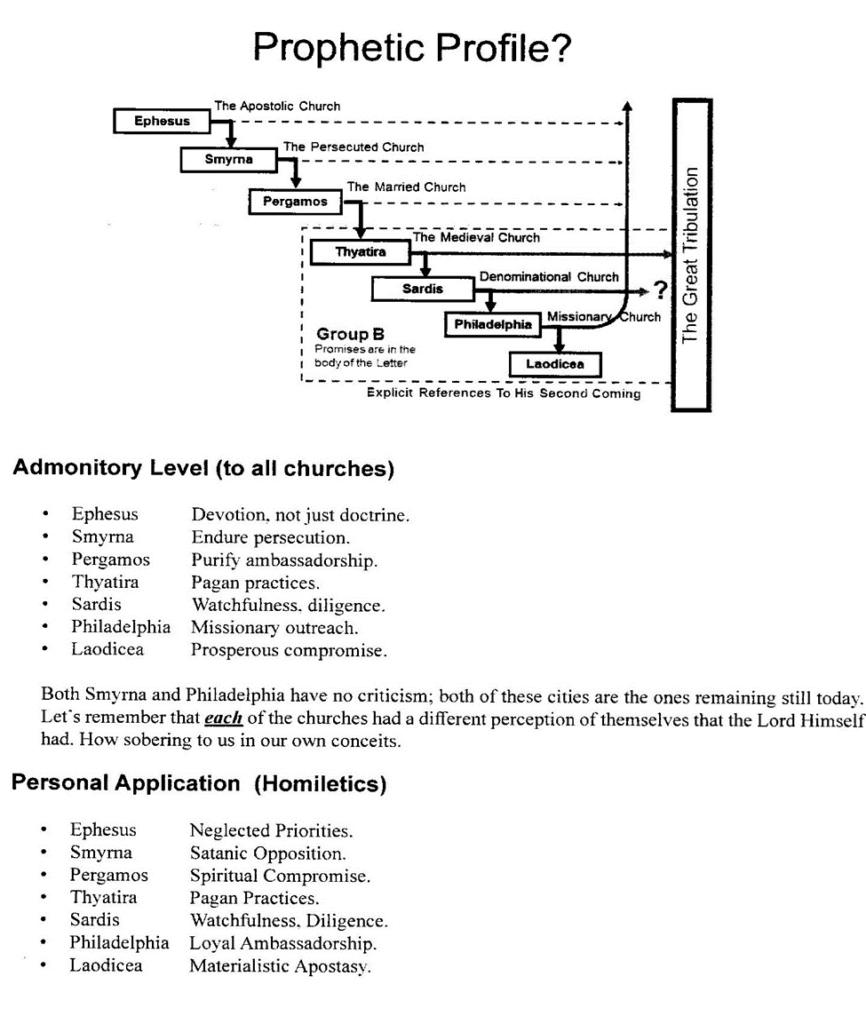
Second, it is an admonition to the churches – all of them. All of the messages were to be read by all of the churches, even if it was not addressed to them. Each letter applies in some way to each church. Once you discover the real theme of each letter, you can profile any church you’ve been in, good, bad or indifferent, in terms of those seven characteristics.
Third, the messages apply to all of us. “He who has an ear…” How many of you have ears? Then these messages are for you too, personally.
Fourth, and this is perhaps the most interesting point – the letters are prophetic. In their particular order, these seven letters lay out the history of the church in advance. (They fill the gaps implied in Daniel 9:26 and between Revelation 12:5 and 6). If they had been presented in any other order, then it would not be true. This is not a coincidence or an accident, this is a design from outside our time domain.
12 Then I turned to see the voice that was speaking with me. And having turned I saw seven golden lampstands;
Lampstands, (not ‘candlesticks) = luchina: light bearers. Every local church is the bearer of God’s light in this dark world (Daniel 7:9-14). This scene should remind us of the tabernacle. The high priest had the sole oversight of the menorah. He lit the lamps, trimmed the wicks, and poured the oil. If one of them was unsatisfactory, he was the one who snuffed it out (cf. John 15:1-6, and 1 John 5:16). *You and I can be set aside. But not even the Prodigal son lost his sonship. Thank God for that. Restoration of our relationship with God is as close as 1 John 1:9.
The lampstands represent the churches – verified expressly in 2:5 and in 1:20 where He warns the church of Ephesus that if they don’t repent, He will remove their lampstand out of their place.
13 and in the middle of the lampstands I saw one like a son of man, clothed in a robe reaching to the feet, and girded across His chest with a golden sash. 14 His head and His hair were white like white wool, like snow; and His eyes were like a flame of fire. 15 His feet were like burnished bronze, when it has been made to glow in a furnace, and His voice was like the sound of many waters.
‘in the middle…’ = where is Jesus right now?
‘Son of Man’ = used 85 times in the gospels (83 by Christ Himself) cf. Psalm 3:4, Revelation 14:14 – denoting Jesus
The physical description is reminiscent of Matthew 17 (Transfiguration) and Daniel 7 (Ancient of Days).
16 In His right hand He held seven stars, and out of His mouth came a sharp two-edged sword; and His face was like the sun shining in its strength.
(Hebrews 4:12
For the word of God is living and active and sharper than any two-edged sword, and piercing as far as the division of soul and spirit, of both joints and marrow, and able to judge the thoughts and intentions of the heart.)
17 When I saw Him, I fell at His feet like a dead man. And He placed His right hand on me, saying, “Do not be afraid; I am the first and the last, 18 and the living One; and I was dead, and behold, I am alive forevermore, and I have the keys of death and of Hades.
Bring this up anytime you speak to a Jehovah’s Witness (who do not believe Jesus Christ is God). Have them read Isaiah 44:6 and 48:12 and ask them who is speaking. They will undoubtedly say, ‘That’s Jehovah God’. Then ask them who is speaking in Revelation 1:17-18, and 2:8, that say the same things from Isaiah, but this time declaring that He was dead and now alive forevermore.
19 Therefore write the things which you have seen, and the things which are, and the things which will take place after these things.
Here we have a nice concise outline of the whole book – the things which you have seen (chapter one), the things which are (chapters two and three) and the things which will take place after these things (chapters four through twenty-two). ‘Meta- tauta’ = after these things.
Revelation chapters 2 and 3 – The Seven Churches –‘The Things That Are’
Always be careful when reviewing Biblical material that is familiar as we think ‘we already have it.’ The only assurance against truth is the presumption that we already have it. Resist the temptation to skim over Biblical passages with which you are familiar – big mistake! – even John 3:16 which everyone has memorized – maybe you haven’t meditated on what the word ‘begotten’ means as it pertains to a Son. Even angels are called ‘sons of God’ in the OT as are men in some cases. So don’t presume you have full understanding of any passage. We should let the Holy Spirit speak to us afresh with each reading. Because the Word of God is inexhaustible. So set aside your presuppositions and let’s see what the Lord Jesus Christ penned in these seven epistles. Yes, there are 28 epistles in the New Testament!
The word epistle comes from the Greek word epistole that means “letter” or “message.”
You will hear the term ‘Pauline epistles’. Ones written by Paul were dubbed ‘Pauline’. Romans is the first Pauline epistle of the NT.
The Pauline epistles are Romans, 1 and 2 Corinthians, Galatians, Ephesians, Philippians, Colossians, 1 and 2 Thessalonians, 1 and 2 Timothy, Titus, and Philemon.
Within this group of Pauline Epistles is a subgroup labeled the Prison Epistles (Ephesians, Philippians, Colossians, and Philemon) so-called because they were written during Paul’s two-year house arrest in Rome (Acts 28:30–31).
The Pastoral Epistles (1 and 2 Timothy and Titus) were written to church leaders and include many teachings regarding practices within the early church.
So there are 13 Pauline epistles.
Following these writings are eight General Epistles (sometimes called ‘Catholic’ Epistles, since they were written to a “universal” audience) that include Hebrews, James, 1 and 2 Peter, 1, 2, and 3 John, and Jude.
The author of Hebrews is unknown (though many have historically attributed the book to Paul or one of Paul’s associates like Barnabas, but if an epistle is written by Paul, he always says so at the beginning).
James was one of the earliest New Testament writings and was written by James, the half-brother of Jesus (1 Corinthians 15:7).
The apostle Peter wrote 1 and 2 Peter.
The apostle John (the same author of the Gospel of John and Revelation) wrote 1 John, 2 John, and 3 John.
The short Epistle of Jude was written by Jude, another half-brother of Jesus.
This adds up to 21 epistles, but there are actually a total of 28 epistles in the NT and the remaining seven were written by Jesus Christ Himself. These are found in Revelation chapters 2 and 3.
The church is not an organization or a building. Biblically, the church is an organism. It grows.
The book of Acts is a portrayal of the first 30 years of the church, from chapter two onward.
But whose ‘Acts’ does it document? Some say the apostles (though one of the three people prominently featured (Philip, Peter and Paul) was not an apostle – Philip – was a deacon (this is not the apostle Philip)), most say it documents the acts of the Holy Spirit. But throughout the Bible, the Holy Spirit never brings attention to Himself. Jesus says this Himself in John 16:13-14. The Holy Spirit points people to Jesus. And every page, every sermon of Acts is centered on Jesus Christ and His resurrection. And when the Holy Spirit is in a metaphor, He is always the ‘unnamed Servant’ (In Genesis 24 an unnamed servant introduces Rachel to Isaac (though you can tell his name by going back to 15:2 where he is named as Eliezer which means ‘comforter’).
*So the first 30 years of the Church are documented in Acts. The next 2000 years are summarized in seven letters to seven churches in Revelation chapters 2 and 3, written (dictated) by none other than the Lord Jesus Himself.
Revelation has 404 verses, 22 chapters (same number as letters in the Hebrew aleph-bet), and over 800 allusions from the Old Testament.
*The reason Revelation sounds so strange to our ears and is so intimidating for a lot of people to study, is that we haven’t done our homework. Again, Revelation is written in code, but every code is revealed elsewhere in scripture, mostly from the Old Testament.
If you track down each of the idioms or metaphors used, you will realize there are over 200 kinds of figures of speech and rhetorical devices used in the Bible (these are catalogued in the book ‘Cosmic Codes’ available at khouse.org)
Revelation chapters 2 and 3 can be called ‘the ultimate report card’.
Each of the seven letters to the churches is composed of seven elements in a pattern.
- Each one starts with the name of the church, and the name of each church is a clue to the key message to that church. Each church has a unique set of situations and the name of each typifies that.
- Jesus selects a title of Himself as the sender. He picks a title that emphasizes the message He is getting across to that particular church.
- There is a commendation – here’s what you’ve done well,
- There is a criticism – here’s what you haven’t done so well,
- Exhortation – coaching – here’s what you need to do differently
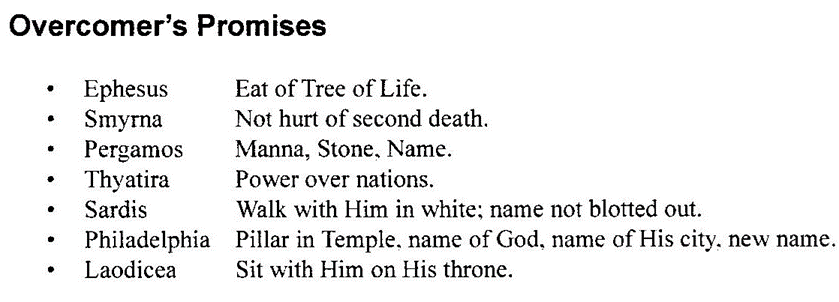
- Promise to the Overcomer
- ‘He who has an ear, hear what the Spirit says to the churches.’
*It’s a performance review for these churches. Now take a moment and imagine Jesus giving you, personally, a similar performance review. Then think of what kind of review He would give Village Church.
Ecclesiology is the study of church doctrine.
EPHESUS
Message to Ephesus (NASB)
2 “To the angel of the church in Ephesus write:
The One who holds the seven stars in His right hand, the One who walks among the seven golden lampstands, says this:
2 ‘I know your deeds and your toil and perseverance, and that you cannot tolerate evil men, and you put to the test those who call themselves apostles, and they are not, and you found them to be false; 3 and you have perseverance and have endured for My name’s sake, and have not grown weary. 4 But I have this against you, that you have left your first love. 5 Therefore remember from where you have fallen, and repent and do the deeds you did at first; or else I am coming to you and will remove your lampstand out of its place—unless you repent. 6 Yet this you do have, that you hate the deeds of the Nicolaitans, which I also hate. 7 He who has an ear, let him hear what the Spirit says to the churches. To him who overcomes, I will grant to eat of the tree of life which is in the Paradise of God.’
The Message to the Church in Ephesus (NLT)
2 “Write this letter to the angel of the church in Ephesus. This is the message from the one who holds the seven stars in his right hand, the one who walks among the seven gold lampstands:
2 “I know all the things you do. I have seen your hard work and your patient endurance. I know you don’t tolerate evil people. You have examined the claims of those who say they are apostles but are not. You have discovered they are liars. 3 You have patiently suffered for me without quitting.
4 “But I have this complaint against you. You don’t love me or each other as you did at first! 5 Look how far you have fallen! Turn back to me and do the works you did at first. If you don’t repent, I will come and remove your lampstand from its place among the churches. 6 But this is in your favor: You hate the evil deeds of the Nicolaitans, just as I do.
7 “Anyone with ears to hear must listen to the Spirit and understand what he is saying to the churches. To everyone who is victorious I will give fruit from the tree of life in the paradise of God.
Ephesus Means ‘the desired one, darling’. Elsewhere in scripture: Acts 19, Ephesians (entire book), 1 John (his epistle to Ephesus).
Christ selects a title for Himself that uses idioms from chapter one, that are also idioms for the church. We are in His hand, He holds the seven stars in His right hand, at the same time, He also walks among us.
Then the commendation: “I know thy works.” He knows what we’re doing. He has a running tally of exactly where we stand. Reading the rest of the letter to Ephesus, hearkens back to Acts 20:17-38 and Paul’s heartfelt farewell to the elders of Ephesus. So far, in verses 2:2-3 it sounds great! And this echoes what Paul had warned them about in Acts 20:28-31.
But then the hammer falls in verse 4. BUT He tells them that they’d left their first love. They were apparently so busy on the business of the kingdom that they had no time for the king. So they are strong in doctrine, but not diligent in their devotional life. And that’s where we grow – in our devotional life. We grow in knowledge by studying the Word. But we grow spiritually through our devotional life.
And that’s when we develop intimacy with God. What does God prefer more – intimacy or works? David wrote many of the Psalms, which testify to his intimacy. And what did God call David? A man after His own heart.
So, from this He gives them a specific exhortation in verse 5. So they have to make a change. If they don’t make a change, will they be unsaved? Of course not. But they may lose their witness. Where is the lampstand at Ephesus today? Well the city physically is a marshland – what was once a key city in Asia Minor is now a desolation.
Who were the Nicolaitans? Historians think they were a first century sect that sought to use their clerical stature or position to rule over the laity (‘Nicao’ = conquer, ‘laos’ = laity), thought to be an allusion to the emergence of the professional clergy. They wanted to put the people back under the law. Not God’s law, but their law. Nicolas (mentioned in Acts) (St. Nicolas?) wasn’t the originator, but people acting falsely in his name apparently.
*Jesus gave us His organizational chart in John 13:3-17 where the Master washes His disciples’ feet. He’s looking for people with a servant’s heart, not a ruling heart.
Then a P.S. in the second half of verse 2:7. Notice a subtlety here that is not true of all the letters – the promise to the overcomer is appended to the letter, not in the letter. This is true of the first three letters and not true of the last four. Significance?
Ephesus represents the *Apostolic Church period*.
SMYRNA
Message to Smyrna (NASB)
8 “And to the angel of the church in Smyrna write:
The first and the last, who was dead, and has come to life, says this:
9 ‘I know your tribulation and your poverty (but you are rich), and the blasphemy by those who say they are Jews and are not, but are a synagogue of Satan. 10 Do not fear what you are about to suffer. Behold, the devil is about to cast some of you into prison, so that you will be tested, and you will have tribulation for ten days. Be faithful until death, and I will give you the crown of life. 11 He who has an ear, let him hear what the Spirit says to the churches. He who overcomes will not be hurt by the second death.’
The Message to the Church in Smyrna (NLT)
8 “Write this letter to the angel of the church in Smyrna. This is the message from the one who is the First and the Last, who was dead but is now alive:
9 “I know about your suffering and your poverty—but you are rich! I know the blasphemy of those opposing you. They say they are Jews, but they are not, because their synagogue belongs to Satan. 10 Don’t be afraid of what you are about to suffer. The devil will throw some of you into prison to test you. You will suffer for ten days. But if you remain faithful even when facing death, I will give you the crown of life.
11 “Anyone with ears to hear must listen to the Spirit and understand what he is saying to the churches. Whoever is victorious will not be harmed by the second death.
Smyrna refers to myrrh, which was an embalming ointment. (And a gift from the Magi to portend baby Jesus’ eventual death). ‘Smyrna’ denotes ‘suffering’ and ‘death’. This church was under brutal persecution at the time, so Christ’s title for Himself in verse 8 is in keeping with that theme. They would take comfort in this title for Christ. And we need to remember that we do not serve a dead Christ, but a living Lord.
‘first and last’ Cf Isaiah 44:6 and 48:12.
Commendation at the start of 2:9. They were materially poor, but God says they are rich in what really matters.
Each recipient of these letters was probably surprised. Those who thought they were doing well, really weren’t. Those who didn’t think they were doing well were doing better than they thought. That in itself should sober us a little bit. It means our own assessment is probably not on the mark, and this should help us get things on the mark.
The allusion in 2:9 ‘The synagogue of Satan, who say they are Jews but are not’, is repeated in 3:9. Who could these be? Most likely the Edomites. Goes back to Esau and Jacob who started fighting while they were still in the womb! Esau sold his birthright to Jacob, then regretted it. And the author of Hebrews (12:15-17) makes a big point of all of that, but to really understand this, you need to understand the subsequent history of the Edomites. When Esau could not get a blessing from Isaac, he deliberately married into the Ishmaelites (his uncle’s family) to upset his parents. And he becomes the primary leader of the people who are hostile to Israel. When the Babylonians are taking the Israelites captive to Babylon, the Edomites stood on the periphery and cheered the Babylonians on and jeered the Israelites telling the Babylonians to ‘crush the skulls of their babies against the rocks!’ (lamented in Psalm 137:7-9). The book of Obadiah prophesies against Edom, as does Jeremiah chapter 49. For more on this, go to https://www.gotquestions.org/Edomites.html.
Antiochus Epiphanes was so cruel (remember, he was the one responsible for the original Abomination of Desolation prophesied in Daniel 11:30-32 and he did this by sacrificing a pig on the altar in Jerusalem) he inspired the Maccabean revolt which threw off the yoke of the Greek empire (this revolt has been celebrated since with Hanukkah, the Jewish Festival of Lights. It is mentioned in John 10:22 as the Feast of the Dedication). This victory by the Maccabees ushered in a period of history of self-rule by the Hasmoneans (~140 BC to ~63 BC).
During the reign of the Hasmoneans, the Edomites were forced to become Jews or die (a rare inversion – usually Jews are the ones forced to recant their faith and become Catholics, etc).
So years later, after Rome took over, to the Roman mind, this tension between the Jews and Edomites was merely a ‘family squabble’. In fact, an Edomite was considered to be a ‘kind of Jew’ which is why Herod (an Edomite) was installed as king, as they thought they were appointing a kind of Jew (who only became Jews on threat of death remember) to govern the province and he would be accepted accordingly. They didn’t appreciate the depths of the animosity – the first Herod killed all the male babies in Bethlehem, another Herod kills John the Baptist, another one kills James. So the point is, as time goes on, there is a blurring of the lines between Jew and Edomite in the minds of everyone BUT the Jews. (For more history read a commentary of the book of Obadiah).
The Jews today have been accused of aspiring to run all the banks, etc. as people like Rothschilds (‘Red Shields’ in German), etc. have been at the heart of it, but these are not Jews at all, they descend from Edomite lines.
Many of them say they are Jews, but are not. The synagogue of Satan. The allusion here is likely to the traditional enemies of the Jews, the Edomites.
Lots can be said about verse 10. Remember Ephesians 6:12. We tend to blame the person or circumstances for our pain but that is often not the appropriate target. Satan hates us, the bride of Christ, as much as he hates Jehovah’s wife, Israel. Read John 10:10 and 1 Peter 5:8-10 as well. We need to defend ourselves by following Ephesians 6:11 and 6:13-18.
The ‘tribulation for ten days’, as we mentioned when we were discussing the possible ‘gap period’ between the Rapture and the onset of the Tribulation, may be a dual focus prophecy. Certainly, there were ten intense periods of persecution by ten Roman emperors starting with…
- Nero (64-68 AD)(Paul was beheaded under his reign),
- Domitian (95-96 AD) (John was exiled during that period – he returned only after Domitian died)
- Trajan (104-117 AD) (Ignatius was burned at the stake)
- Marcus Aurelius (161-180 AD) (Polycarp was martyred (see Foxe’s Book of Martyrs))
- Severus (200-211 AD)
- Maximinius (235-237 AD)
- Decius (250-253 AD)
- Valerian (257-260 AD)
- Aurelian (270-275 AD)
- Diocletian (303-313 AD) (the worst emperor of all)
We will look further into these ten (briefly) during our talk on Revelation 17 by John Courson.
Obviously, this time period spans far more than ten days (more like 210 years from when it was written), so if this is the application, it is obvious allegory.
So with that in mind, we entertained the possibility in our talk on Session 3 that this could also be an allusion to a ten year period (including the seven year Tribulation) between the Rapture and Second Coming, during which the Jews will be ALSO be severely persecuted.
Remember, that after the ‘fullness of the gentiles comes in’ (the Rapture) the Jews’ veil will be lifted and they will take a sudden interest in the New Testament, and will come across this verse.
The last sentence of 2:9 reveals yet another crown for believers. All the crowns documented in scripture are described on pages 54-55 of the book ‘Charting the End Times’ that big purple book everyone was given.
*Note that no criticism is given to Smyrna (or to Philadelphia).
Then the addendum of the last sentence of 2: 11, outside of the body of the letter. A post script.
Smyrna represents the *Persecuted Church period*.
PERGAMUM
Message to Pergamum (NASB)
12 “And to the angel of the church in Pergamum write:
The One who has the sharp two-edged sword says this:
13 ‘I know where you dwell, where Satan’s throne is; and you hold fast My name, and did not deny My faith even in the days of Antipas, My witness, My faithful one, who was killed among you, where Satan dwells. 14 But I have a few things against you, because you have there some who hold the teaching of Balaam, who kept teaching Balak to put a stumbling block before the sons of Israel, to eat things sacrificed to idols and to commit acts of immorality. 15 So you also have some who in the same way hold the teaching of the Nicolaitans. 16 Therefore repent; or else I am coming to you quickly, and I will make war against them with the sword of My mouth. 17 He who has an ear, let him hear what the Spirit says to the churches. To him who overcomes, to him I will give some of the hidden manna, and I will give him a white stone, and a new name written on the stone which no one knows but he who receives it.’
The Message to the Church in Pergamum (NLT)
12 “Write this letter to the angel of the church in Pergamum. This is the message from the one with the sharp two-edged sword:
13 “I know that you live in the city where Satan has his throne, yet you have remained loyal to me. You refused to deny me even when Antipas, my faithful witness, was martyred among you there in Satan’s city.
14 “But I have a few complaints against you. You tolerate some among you whose teaching is like that of Balaam, who showed Balak how to trip up the people of Israel. He taught them to sin by eating food offered to idols and by committing sexual sin. 15 In a similar way, you have some Nicolaitans among you who follow the same teaching. 16 Repent of your sin, or I will come to you suddenly and fight against them with the sword of my mouth.
17 “Anyone with ears to hear must listen to the Spirit and understand what he is saying to the churches. To everyone who is victorious I will give some of the manna that has been hidden away in heaven. And I will give to each one a white stone, and on the stone will be engraved a new name that no one understands except the one who receives it.
Also called ‘Pergamos’ – root is ‘gamy’ – from where we get ‘monogamy’, ‘bigamy’, ‘gamete’ which means ‘marriage’. ‘Pergamy’ is a perverted marriage or false marriage, where the church marries the world in effect. Pergamos is also known as the ‘City of the Serpent’.
Jesus gives the title for Himself in 2:12. What is the sharp sword with two edges? The Word of God. It’s the Word of God that is the need of this church. This hearkens back to 1:16.
2:14. To really understand the flavor of the indictment here you need to study who Balaam was. He was a prophet out of Mesopotamia, Balak was the king who was averse to Israel. The account is given in Numbers 22-24. See a summary here…
https://www.gotquestions.org/Balaam-in-the-Bible.html
Question: “Who was Balaam in the Bible?”
Answer: Balaam was a wicked prophet in the Bible and is noteworthy because, although he was a wicked prophet, he was not a false prophet. That is, Balaam did hear from God, and God did give him some true prophecies to speak. However, Balaam’s heart was not right with God, and eventually he showed his true colors by betraying Israel and leading them astray.
In Numbers 22—24, we find the story about Balaam and the king of Moab, a man called Balak. King Balak wanted to weaken the children of Israel, who on their way to Canaan had moved in on his territory. Balak sent to Balaam, who lived in Mesopotamia along the Euphrates River (Numbers 22:5), and asked him to curse Israel in exchange for a reward. Balaam was apparently willing to do this but said he needed God’s permission (verse 8). Balaam, of course, had no power, in himself, to curse Israel, but, if God were willing to curse Israel, Balaam would be rewarded through Balak. God told Balaam, “You must not put a curse on those people, because they are blessed” (verse 12). King Balak then sent “other officials, more numerous and more distinguished than the first” (verse 16), promising a handsome reward. This time God said, “Go with them, but do only what I tell you” (verse 20).
The next morning, Balaam saddled his donkey and left for Moab (Numbers 22:21). God sent an angel to oppose Balaam on the way. The donkey Balaam was riding could see the angel, but Balaam could not, and when the donkey three times moved to avoid the angel, Balaam was angry and beat the animal. “Then the Lord opened the donkey’s mouth” (verse 28), and it rebuked the prophet for the beatings. “Then the Lord opened Balaam’s eyes, and he saw the angel of the Lord standing in the road with his sword drawn” (verse 31). The angel told Balaam that he certainly would have killed Balaam had not the donkey spared his life. Ironically, a dumb beast had more wisdom than God’s prophet. The angel then repeated to Balaam the instruction that he was only to speak what God told him to speak concerning the Hebrews (verses 33–35).
In Moab, King Balak took the prophet Balaam up to a high place called Bamoth Baal and told him to curse the Israelites (Numbers 22:41). Balaam first offered fourteen sacrifices on seven altars and met with the Lord (Numbers 23:1–5). He then declared the message God gave him: a blessing on Israel: “How can I curse / those whom God has not cursed? / How can I denounce / those whom the Lord has not denounced?” (verse 8).
King Balak was upset that Balaam had pronounced a blessing on Israel rather than a curse, but he had him try again, this time from the top of Pisgah (Numbers 23:14). Balaam sacrificed another fourteen animals and met with the Lord. When he faced Israel, Balaam again spoke a blessing: “I have received a command to bless; / he has blessed, and I cannot change it” (verse 20).
King Balak told Balaam that, if he was going to keep blessing Israel, it was better for him to just shut up (Numbers 23:25). But the king decided to try one more time, taking Balaam to the top of Peor, overlooking the wasteland (verse 28). Again, Balaam offered fourteen animals on seven newly built altars (verse 29). Then “the Spirit of God came on him and he spoke his message” (Numbers 24:2–3). The third message was not what the Moabite king wanted to hear: “How beautiful are your tents, Jacob, / your dwelling places, Israel!” (verse 5).
Balaam’s three prophecies of blessing on Israel infuriated the king of Moab, who told the prophet to go back home with no reward: “Now leave at once and go home! I said I would reward you handsomely, but the Lord has kept you from being rewarded” (Numbers 24:11). Before he left, Balaam reminded the king that he had said from the very beginning he could only say what God told him to say. Then he gave the king four more prophecies, gratis. In the fourth prophecy, Balaam foretold of the Messiah: “A star will come out of Jacob; / a scepter will rise out of Israel. / He will crush the foreheads of Moab, / the skulls of all the people of Sheth” (verse 17). Balaam’s seven prophecies were seven blessings on God’s people; it was God’s enemies who were cursed.
However, later on Balaam figured out a way to get his reward from Balak. Balaam advised the Moabites on how to entice the people of Israel with prostitutes and idolatry. He could not curse Israel directly, so he came up with a plan for Israel to bring a curse upon themselves. Balak followed Balaam’s advice, and Israel fell into sin, worshiping Baal of Peor and committing fornication with Midianite women. For this God plagued them, and 24,000 men died (Numbers 25:1–9; Deuteronomy 23:3–6).
Balaam’s name and story became infamous, and he is referred to several times in the New Testament. Peter compares false teachers to Balaam, “who loved the wages of wickedness” (2 Peter 2:15). Jude echoes this sentiment, associating Balaam with the selling of one’s soul for financial gain (Jude 1:11). Finally, Jesus speaks of Balaam when He warns the church in Pergamum of their sin: “There are some among you who hold to the teaching of Balaam, who taught Balak to entice the Israelites to sin so that they ate food sacrificed to idols and committed sexual immorality” (Revelation 2:14). Satan’s tactics haven’t changed all that much. If he cannot curse God’s people directly, he will try the back-door approach, and idolatry and sexual immorality are his go-to temptations.
(My summary: Balaam counseled the king in how to defeat Israel by casting a stumbling block before them – get pretty girls to camp around the periphery and get Israel to sin, then God would judge them.)
So there were some in the church at Pergamum encouraging its members to eat things sacrificed to idols and enjoy immorality, just like Balaam had advised millennia prior.
The ‘doctrine of Balaam’ is spiritual unchastity, marriage with the world. (Rev. 2:14 …the teaching of Balaam, who kept teaching Balak to put a stumbling block before the sons of Israel, to eat things sacrificed to idols and to commit acts of immorality.)
The ‘way of Balaam’ is to be a hireling, to making a market for his gift (2 Peter 2:15 15 forsaking the right way, they have gone astray, having followed the way of Balaam, the son of Beor, who loved the wages of unrighteousness;)
The ‘error of Balaam’ is to sacrifice eternal riches for temporal gain. (Jude 11 – 11 Woe to them! For they have gone the way of Cain, and for pay they have rushed headlong into the error of Balaam, and perished in the rebellion of Korah.)
The indictment continues with another allusion to the Nicolaitans (see above).
Exhortation (warning) in verse 2:16.
And again a P.S. added on in verse 2:17. Maybe we too will get new names known only to us and God Himself. That would be a special kind of intimacy.
Pergamos represents the *Married Church Era*. (when the church marries the world)
Constantine and the Council of Nicaea in 325 AD the first ecumenical council of the church, 1800 bishops were invited, 1000 from the east and 800 from the west, but less than 400 attended, (318 was the official count for posterity) and resulting in the Nicene Creed. They also developed church canons – the first canon dealt with men who castrated themselves. The Council was a protest of sorts against Arianism, which did not believe Jesus was God. This is not Hitler’s Aryanism, btw, but teachings from a guy named Arius. They also sought to distance Christianity from Judaism, especially Easter vs. Passover. (Easter itself was named after a Babylonian belief in Ashtaroth). John Courson will detail this more in the talk on Revelation 17.
THYATIRA
Message to Thyatira (NASB)
18 “And to the angel of the church in Thyatira write:
The Son of God, who has eyes like a flame of fire, and His feet are like burnished bronze, says this:
19 ‘I know your deeds, and your love and faith and service and perseverance, and that your deeds of late are greater than at first. 20 But I have this against you, that you tolerate the woman Jezebel, who calls herself a prophetess, and she teaches and leads My bond-servants astray so that they commit acts of immorality and eat things sacrificed to idols. 21 I gave her time to repent, and she does not want to repent of her immorality. 22 Behold, I will throw her on a bed of sickness, and those who commit adultery with her into great tribulation, unless they repent of her deeds. 23 And I will kill her children with pestilence, and all the churches will know that I am He who searches the minds and hearts; and I will give to each one of you according to your deeds. 24 But I say to you, the rest who are in Thyatira, who do not hold this teaching, who have not known the deep things of Satan, as they call them—I place no other burden on you. 25 Nevertheless what you have, hold fast until I come. 26 He who overcomes, and he who keeps My deeds until the end, to him I will give authority over the nations; 27 and he shall rule them with a rod of iron, as the vessels of the potter are broken to pieces, as I also have received authority from My Father; 28 and I will give him the morning star. 29 He who has an ear, let him hear what the Spirit says to the churches.’
The Message to the Church in Thyatira (NLT)
18 “Write this letter to the angel of the church in Thyatira. This is the message from the Son of God, whose eyes are like flames of fire, whose feet are like polished bronze:
19 “I know all the things you do. I have seen your love, your faith, your service, and your patient endurance. And I can see your constant improvement in all these things.
20 “But I have this complaint against you. You are permitting that woman—that Jezebel who calls herself a prophet—to lead my servants astray. She teaches them to commit sexual sin and to eat food offered to idols. 21 I gave her time to repent, but she does not want to turn away from her immorality.
22 “Therefore, I will throw her on a bed of suffering, and those who commit adultery with her will suffer greatly unless they repent and turn away from her evil deeds. 23 I will strike her children dead. Then all the churches will know that I am the one who searches out the thoughts and intentions of every person. And I will give to each of you whatever you deserve.
24 “But I also have a message for the rest of you in Thyatira who have not followed this false teaching (‘deeper truths,’ as they call them—depths of Satan, actually). I will ask nothing more of you 25 except that you hold tightly to what you have until I come. 26 To all who are victorious, who obey me to the very end,
To them I will give authority over all the nations.
27 They will rule the nations with an iron rod
and smash them like clay pots.
28 They will have the same authority I received from my Father, and I will also give them the morning star!
29 “Anyone with ears to hear must listen to the Spirit and understand what he is saying to the churches.
From Greek, ‘thygater’ = daughter. So named, because one of Alexander’s four generals (Nicator (aka Seleucus I) was informed that a daughter had just been born to him. He named her ‘Jezebel’. An alternate meaning of thygater was ‘continual sacrifice’. Area was known for its purple dyes.
Jesus’ title for Himself in 2:18. He declares that He’s the Son of God, not the mother of God. (The point made, because Thyatira was previously named ‘Semiramis’ the fabled consort and mother of Nimrod whose incest-produced offspring was their son Tammuz). From Wikipedia.org…
www.https://en.wikipedia.org/wiki/Semiramis
“Hislop believed that Semiramis was a queen consort and the mother of Nimrod, builder of the Bible’s Tower of Babel, although the Bible does not mention him having any consorts. He said that Semiramis and Nimrod’s incestuous male offspring was the Akkadian deity Tammuz, and that all divine pairings in religions were retellings of this story.”
*It is the longest of the letters and is very pointed.
*A nice commendation in verse 2:19.
*But then the critique in 2:20-23. She is promised ‘great tribulation’ unless she repents. Which means if she repents then she won’t get the tribulation.
The idioms here echo the story of Jezebel in 1 Kings 21. There is an episode there that is very revealing that the Lord is making allusions to here. At that time, Queen Jezebel was married to King Ahab who is a very rich king but there’s a guy by the name of Naboth who has a really neat little vineyard that’s nearby. And Ahab wants that vineyard, so he goes to Naboth who does not want to sell. So the king goes into a pout about it. The queen tells Ahab, ‘let me handle it’. So Jezebel arranges an inquisition. She gets some people to make false statements about Naboth that get him murdered. She gets the land and gives it to Ahab and gloats to him. ‘See what I did for you. False witnesses, condemnation, execution, and Naboth’s vineyard is seized for the king’.
Does this metaphorically describe a period of the church? Think about it. Read Dave Hunt’s book, ‘A Woman Rides the Beast’ for a possible answer to this question. Note that on May 21, 1995 the Pope asked forgiveness for all wrongs and crimes committed and permitted by the Roman Catholic Church throughout their history.
See 2:26. Finishing well is the name of the game. Are you and I on track to finish well before we are raptured?
And this time, strangely, we have the promise to the overcomer in the body of the letter.
Thyatira represents the *Medieval Church Period*, esp the Catholic Church (not ‘catholic’ as in ‘universal’ but the specific faith system of popes (“papa”) (Matthew 23:9) etc. The Catholic Bible (DRA) has removed the second commandment (about making idols and graven images), and split the last commandment into two, so it still adds up to ten. It also has changed Genesis 3:15 to say ‘she shall crush thy head (meaning Mary), and thou shalt lie in wait for her heel.’ Statues of Mary have her standing on a snake. The dove is a symbol of the HS in the NT but they make the dove symbolic of Mary. Catholics will tell you that they don’t pray to Mary or other saints, yet they must give her adoration. Adoration is the same as worship. Only a priest can forgive sins, not in private prayer to Jesus. Pope calls himself the Vicar of Christ, he is in the seat of Christ, he is in place of Christ on this earth, and when the pope is on his throne, he is infallible. So commits blasphemy. Over 50M people were killed by the papacy during the Inquisition. Where else do you see an organization that says they forgive sins and sit in the place of God? Only the Catholic church. The beast in both Daniel and Revelation utters such blasphemies. And today, the pope is calling for unity of world religions. This hybrid of religions remaining after the rapture with Catholicism as its head, will become the Whore of Babylon, used by the Beast for a time, then destroyed by it, wanting all worship to be directed to himself instead. (MUST VERIFY THIS LAST PARAGRAPH) God says, ‘Come out from her!’ Because she is going to be judged harshly and you with her will be held responsible for all that she did. And Protestants did come out! But lately we’re trying to go back in! (See beginning of ‘The Woman Rides the Beast’ by Dave Hunt regarding the ecumenical movement that has pulled in many Protestants.) July 24, 2015 the pope said, ‘the Bible and the Koran are the same! Jesus Christ, Mohammed, Jehovah, Allah, we are all children of God regardless of the name we choose to address Him by. We can accomplish miraculous things in the world by merging our faiths, and the time for such a movement is now. No longer shall we slaughter our neighbors over differences in references to their God.’
Ecumenicalism means ‘lets all become Catholic again’ to the Catholics. Come home to ‘papa’ (papa-cy). Mary is seen as the Queen of Heaven and co-redemptrix as they call her.
SARDIS
‘Sardius’ = ‘Red stone’. Used in ancient times for seals. If Thyatira is the Catholic Church, then Sardis would speak of the Reformation. ‘Reformed’ = Calvinist.
Martin Luther and his antisemitism, later used as ammunition by Hitler. Luther should not be unquestionably venerated. Yes, God used him in a powerful way to rebel against the Catholic church, but he also persecuted God’s chosen people in horrific ways. ‘On the Jews and Their Lies’.
verse 3:1 gives Jesus’ name for Himself here. He declares Himself ‘He who has the seven Spirits of God and the seven stars’. That’s apparently what they’re missing.
Jesus wastes no time getting to the criticism in His opening salutation. How many people have a good, respected reputation they’ve worked hard to build, but are dead? Sobering that it could be us that He’s describing.
They were a church in name only. It speaks of denominationalism.
3:2-3 continue the chastisement coupled with a warning that echoes 1 Thessalonians 5:2…
‘For you yourselves know full well that the day of the Lord will come just like a thief in the night.’
The harpazo (Rapture) will catch them unawares – they will be ushered into the 1 Corinthians 3:10-15 judgement (Bema Seat) and have no reward as they were unprepared.
He comes as a thief only if you are not watching! Verse 3:3 implies that if you ARE watching, you won’t be surprised.
*Read Revelation 3:1-3 right now and imagine Him speaking it to you personally.
3:4 Sardis apparently had a remnant of believers who were walking in righteousness (3:4) and this is the closest Sardis gets to a commendation. Hearkens back to prior faithful remnants mentioned in scripture.
Sardis represents the *Denominational Church Period* specifically the Reformed /Calvinist church.
PHILADELPHIA
‘The Church of Brotherly Love’
Titles for Christ are given in 3:7.
Commendation in verse 3:8.
*Like Smyrna, Philadelphia also had nothing critical said about them.
3:10 is one of the most exciting promises in scripture. Remember, that every church had elements of every letter that applied to them. It is our hope, that 3:10 applies to us (even though in the prophetic timeline, we are in the age of Laodicea) and we will be spared from having to endure the tribulation.
The book of Revelation speaks of the ‘earth dwellers’ in this verse (‘to try them that dwell upon the earth’), in contrast to those who are saved. You and I are not earth dwellers. We may be pilgrims here, but this isn’t our home.
(Hebrews 11:13-16 – 13 All these died in faith, without receiving the promises, but having seen them and having welcomed them from a distance, and having confessed that they were strangers and exiles on the earth. 14 For those who say such things make it clear that they are seeking a country of their own. 15 And indeed if they had been thinking of that country from which they went out, they would have had opportunity to return. 16 But as it is, they desire a better country, that is, a heavenly one. Therefore God is not ashamed to be called their God; for He has prepared a city for them.
and
John17:14-16 14 I have given them Your word; and the world has hated them, because they are not of the world, even as I am not of the world. 15 I do not ask You to take them out of the world, but to keep them from the evil one. 16 They are not of the world, even as I am not of the world.)
3:11 Exhortation/Warning – ‘lest someone take your crown.’ You mean someone can take your crown? Rewards can be won, then lost? Absolutely…
1 Corinthians 3:11-15…
11 For no man can lay a foundation other than the one which is laid, which is Jesus Christ. 12 Now if any man builds on the foundation with gold, silver, precious stones, wood, hay, straw, 13 each man’s work will become evident; for the day will show it because it is to be revealed with fire, and the fire itself will test the quality of each man’s work. 14 If any man’s work which he has built on it remains, he will receive a reward. 15 If any man’s work is burned up, he will suffer loss; but he himself will be saved, yet so as through fire.
We have an inheritance set aside for us but we can blow it. NOT our salvation – Jesus did it all 2000 years ago. Done deal. We can’t add to what He’s done. It’s blasphemy to even try. But we can forfeit the inheritance.
3:12 – some more AWESOME promises!
Philadelphia represents the *Missionary Church Age*.
LAODICEA
Lao = ‘people’, Diceans = rulers. Rule of / by the people = ‘The Self-Satisfied Church’.
Stood halfway between the hot springs of its twin city, Hierapolis six miles away, and the cold waters of Colossae. It was fed by an aqueduct from the hot springs of Hierapolis, and its water was lukewarm when it arrived.
A famous school of medicine was there, especially known for an ophthalmic ointment (a mixture of oil and the collyrium powder) making Jesus’ statement in 3:18 ‘I advise you to buy from Me gold refined by fire so that you may become rich, and white garments so that you may clothe yourself, and that the shame of your nakedness will not be revealed; and eye salve to anoint your eyes so that you may see.’ memorable and applicable.
*Laodicea has NO COMMENDATION.
In the prophetic timeline, this is the church of today, sadly. We have been ‘inoculated’ to the urgency of staying holy and sanctified. Most of us in the Church today are guilty of this. We are addicted to ‘cheap grace’. We think that since we are saved, the race is over for us and all we need to do is wait on the harpazo to take us home.
But in our comfort, in which we feel rich, we are actually ‘poor, blind, and naked’. We have stopped trying for God, stopped trying to live holy lives because as ‘cheap grace’ dictates, Jesus did all the work, so there’s no need for us to try anymore.
Yes, Jesus did all the work necessary for our salvation, but WE are responsible for maintaining our sanctification.
Sanctification is a DAILY struggle for holiness, maintaining intimacy with the Holy Spirit, and fighting against the ‘old nature’, yet most of us are sitting back comfortably that all the work has been done, so now we can just enjoy life on our own terms. And if we happen to sin, no worries, Jesus has that covered for us. Though our sins are still forgiven, our cavalier attitudes will cost us eternal reward, our ‘gold, silver, and precious stones’ of 1 Corinthians 3:10-15. The Church of Laodicea is instructed in 3:18 to… 18 I advise you to buy from Me gold refined by fire so that you may become rich
We have lost the appreciation for what He did for us and have become very lazy and entitled and in the process are losing our eternal reward, the gold of Jesus.
3:14 – Jesus’ title for Himself
3:15-17 – criticism ‘I know your works…’ we cannot hide from God. This is the ONLY church for which our Lord expresses a form of disgust.
|
|
The danger is of having religion enough to lull the conscience, but not to save the soul.
Matthew 7:21-23…
21 “Not everyone who says to Me, ‘Lord, Lord,’ will enter the kingdom of heaven, but he who does the will of My Father who is in heaven will enter. 22 Many will say to Me on that day, ‘Lord, Lord, did we not prophesy in Your name, and in Your name cast out demons, and in Your name perform many miracles?’ 23 And then I will declare to them, ‘I never knew you; depart from Me, you who practice lawlessness.’
3:17 – how many of us are wealthy and comfortable? Compared to the rest of the world, we all are. This verse counters all those Kenneth Copeland / Creflo Dollar / Jesse Duplantis types who preach the prosperity gospel, ‘name it and claim it’, ‘gab it and grab it’. BE CAREFUL.
3:18-19 – advice/exhortation
*3:20 – terribly misunderstood and misused verse. 20 Behold, I stand at the door and knock; if anyone hears My voice and opens the door, I will come in to him and will dine with him, and he with Me.
Where is Jesus? HE’S OUTSIDE WANTING TO BE LET IN! He’s calling out ‘Hey, is ANYONE in there?
Why is He standing outside, when He should be INSIDE the church already! Makes for a nice sounding altar call, and IS appropriate for those who don’t know Christ, but to do so misses the point He is making. Too often we dismiss it as ONLY an altar call verse. NO – THIS IS A REPRIMAND OF THE CHURCH, of US, of YOU and I. Christians spend so much energy on ‘show’. Dressing up for church, fake smiles, fake laughter – it’s all pageantry! We need to be the hands and feet of Jesus, ‘washing feet’ and being genuine. Gossip and hypocrisy are deadly poisons in ALL churches, not just ours.
*We need to repent of everything we do, as individuals, and as a corporate body (Village Church) that strangulates the power of the Holy Spirit, robbing us of His blessing and diminishing our effectiveness.
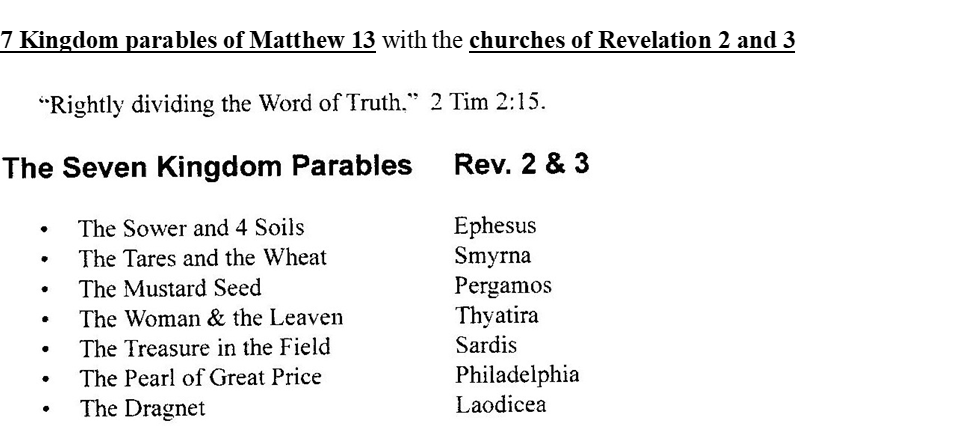
As a final note, seven kingdom parables Jesus gave, recorded in Matthew 13, correspond with the churches described in Revelation chapters 2 and 3. They are listed below (and in the introduction to Revelation) and paired accordingly in the summary. One day, we will explore and dissect them. Many of the parables don’t mean what Christians typically think they mean (especially the parable of the mustard seed), much like nursery rhymes we learned in childhood didn’t mean what we thought they meant.
SUMMARY: Illustrations at the top were copied from pages 136-137 of the ‘Big Notes’, which were taken from Dr. Chuck Missler’s notes on Revelation…